Your sewer line is failing. You need to fix it fast. But should you repair or replace it?
This choice affects your home for decades. It impacts your budget today and your property value tomorrow. The wrong call costs thousands more than it should.
Sewer Experts has fixed Denver sewer lines for over 25 years. We’ve repaired thousands of sewer line systems. We’ve replaced just as many. We know when repair works and when replacement saves you money long-term.
Table of Contents
- Quick Answer: Repair vs Replacement Decision Tree
- When Sewer Line Repair Makes Sense
- When Sewer Line Replacement Is Better
- True Cost Comparison: Repair vs Replacement
- Pipe Materials: How They Affect Your Decision
- Trenchless Solutions for Both Repair and Replacement
- Step-by-Step: Making Your Repair vs Replacement Choice
- Frequently Asked Questions
Quick Answer: Repair vs Replacement Decision Tree
The sewer line repair vs replacement choice depends on five factors. Each factor moves you toward one option or the other.
Here’s how to decide in under two minutes.
Damage Type Determines Your Path
Localized damage means repair works. Your sewer line has one small crack or root intrusion point. The rest of the pipe is solid.
Widespread damage requires replacement. Multiple sections show cracks, corrosion, or collapse. The entire sewer line is compromised.
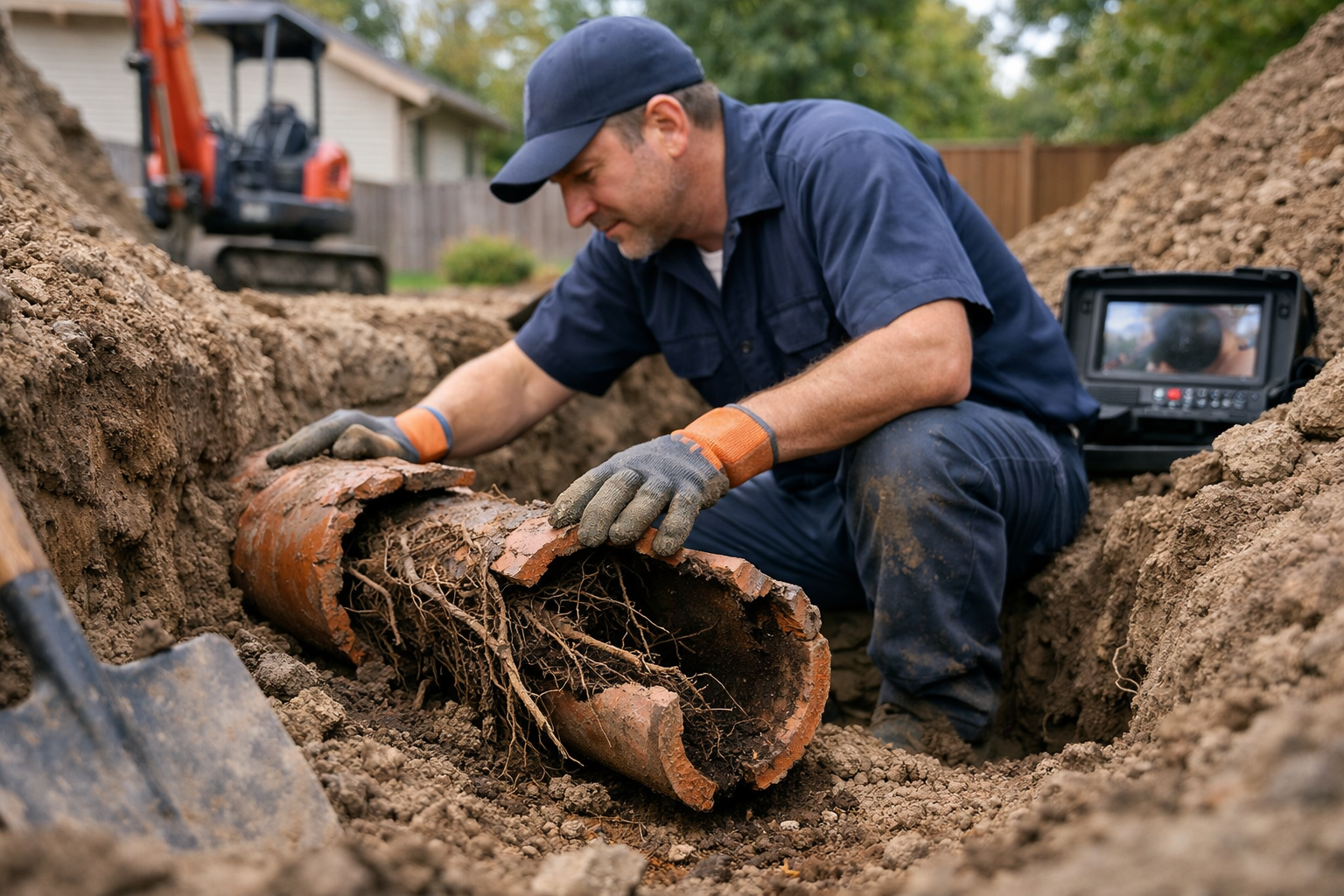
A camera inspection shows exactly what you’re dealing with. We insert a high-resolution camera into your sewer line. You see the damage yourself on our monitor.
Pipe Age Matters More Than You Think
Sewer lines under 30 years old usually respond well to repair. The pipe material still has structural integrity. Repair fixes the problem for years.
Sewer lines over 50 years old need replacement. Clay pipes crack easily. Cast iron corrodes from the inside. Repair just delays the inevitable failure.
Denver homes built before 1970 almost always need sewer line replacement. The original pipes have reached their lifespan limit.
Material Quality Changes Everything
Modern PVC and HDPE pipes last 100+ years. These materials resist root intrusion and corrosion. Repair works great on newer plastic sewer lines.
Clay and cast iron degrade over time. Clay cracks under ground movement. Cast iron rusts through. These materials signal sewer line replacement territory.
Orangeburg pipe always requires replacement. This compressed wood fiber material was common from 1940-1970. It collapses when saturated. Repair is impossible.
Expert Insight from Sewer Experts Team:
“We see homeowners waste money on repeated sewer line repairs when replacement would cost less long-term. A $1,500 repair might seem cheaper than $8,000 replacement. But three repairs in five years cost more than one permanent fix.”
Location Impacts Cost and Choice
Damage under landscaping or driveways increases replacement cost. Excavation means tearing up yards, gardens, or concrete. Repair might save your property from major disruption.
Damage under open lawn areas makes replacement easier. Access is simple. Restoration costs stay low. Sewer line replacement becomes more practical.
Trenchless methods solve location problems for both repair and replacement. We can line or replace your sewer line without destroying your yard.
Future Plans Shape Your Decision
Selling your home soon? Disclosure laws require revealing sewer line issues. Replacement adds value and prevents sale complications. Repair might scare buyers who see it as temporary.
Staying long-term? Calculate the total cost over 10-20 years. Multiple repairs often exceed one replacement cost. Sewer line replacement gives you decades of peace.
Planning renovations? Replace your sewer line now. Future work might require digging anyway. Combine projects to save on excavation costs.
When Sewer Line Repair Makes Sense
Sewer line repair works perfectly in specific situations. You save money and solve your problem permanently when conditions align.
Single Point Damage Scenarios
One tree root broke through your sewer line at a joint. The rest of the pipe shows no damage. Repair fixes this in hours.
We remove the root and seal the crack. Your sewer line works like new. The repair process costs 60-80% less than replacement.
Single point repairs last 10-20 years when done correctly. The surrounding pipe material must be sound. Our camera inspection confirms this before we start.
Recent Pipe Installation Benefits
Your sewer line is less than 15 years old. Modern materials mean the damage is truly isolated. Repair makes total sense.
PVC pipes installed since 2000 rarely need replacement. Even significant damage can be repaired using trenchless methods. Your investment stays protected.
Repair preserves your warranty. Many sewer line installations include 20-25 year warranties. Replacement voids these protections. Repair maintains your coverage.
Budget Constraints and Emergency Needs
You need a working sewer line today. Replacement takes several days. Repair can restore function in 4-6 hours.
Emergency sewer line repair stops immediate problems. Sewage backup destroys property fast. We fix the crisis now. You can plan replacement later if needed.
Repair buys you time to save for replacement. A $1,800 repair might last 5-7 years. This lets you budget for eventual sewer line replacement properly.
Minimal Damage Extent
Less than 30% of your sewer line shows problems. The damaged section is short and accessible. Repair addresses this efficiently.
We calculate repair cost per foot versus replacement cost per foot. When repair costs stay under 40% of replacement cost, repair wins financially.
Your soil conditions support repair longevity. Stable soil means repairs hold strong. Shifting or saturated soil undermines repair attempts. We test this during inspection.
Expert Insight from Sewer Experts Team:
“Denver’s clay soil can shift dramatically with moisture changes. We always check soil conditions before recommending sewer line repair. Some yards can’t support long-term repairs regardless of pipe condition.”
When Sewer Line Replacement Is Better
Sewer line replacement costs more upfront. But it saves you massive money and stress over 20-50 years. Here’s when replacement is the right call.
Multiple Failure Points Throughout
Your camera inspection shows three or more problem areas. Cracks appear every 10-15 feet. Root intrusion happens at multiple joints.
This pattern signals systemic failure. Repairing one spot just moves pressure to the next weak point. You’ll face repeated repairs every 2-3 years.
The EPA guidelines on pipe integrity recommend replacement when damage exceeds 40% of total line length. This prevents ongoing contamination risks.
Old Pipe Material Breakdown
Clay sewer pipes from 1950s-1970s homes crack easily. Tree roots seek moisture and break through joints. The material becomes brittle over 50+ years.
Cast iron sewer lines rust from inside and outside simultaneously. You see orange stains in your toilet tank. The pipe walls thin until collapse occurs.
Orangeburg pipe turns soggy when saturated. This tar-paper product was cheap during post-WWII building booms. It fails catastrophically. No repair method works.
Complete Sewer Line System Upgrade
Your home has outdated 3-inch diameter sewer lines. Modern codes require 4-inch minimum. Replacement brings your system up to current standards.
Increasing family size means more water usage. Your old sewer line can’t handle the flow. Replacement with larger diameter pipe prevents future backups.
Converting to modern PVC gives you 100+ years of service life. The investment pays off through decades of worry-free operation.
Property Value and Sale Planning
You’re selling within 5 years. Buyers increasingly request sewer line inspections. A new replacement adds $15,000-25,000 to your home value in Denver markets.
Disclosure laws require reporting known sewer line issues. Recent repairs raise red flags. Replacement shows the problem is permanently solved.
Replacement removes negotiation leverage from buyers. They can’t demand price reductions for sewer line concerns. Your asking price stays firm.
Chronic Backup and Slow Drain Patterns
You’ve had three sewer line repairs in five years. Problems keep returning. This indicates underlying material failure throughout the system.
Your sewer line backs up every spring when trees grow. Root intrusion is everywhere. Replacement with root-resistant materials stops this cycle.
Calculation time: Three repairs at $1,800 each = $5,400. One replacement at $8,000 means you break even after the third repair. Future repairs cost you more.
True Cost Comparison: Repair vs Replacement
Let’s break down real Denver numbers. These costs reflect actual projects from our 25+ years serving Colorado homeowners.
Sewer Line Repair Costs by Method
Spot repair of single crack: $1,200-2,500. This includes camera inspection, excavation of 3-5 feet, pipe section replacement, and restoration. Takes 4-8 hours.
Trenchless pipe lining for 20-foot section: $2,800-4,500. We insert resin-coated liner through existing pipe. No digging required. Your landscaping stays intact.
Root removal and joint sealing: $800-1,800. We cut roots mechanically and seal entry points. Works when pipe material is otherwise sound. Lasts 5-8 years.
Emergency sewer line repair during backup: Add $500-1,000 to any repair cost. After-hours service and urgent response increase price. Worth it to stop property damage.
Sewer Line Replacement Costs by Method
Traditional excavation replacement, 50-foot line: $6,500-10,000. We dig trench, remove old pipe, install new PVC, backfill, and restore surface. Takes 2-3 days.
Trenchless pipe bursting, same length: $8,000-12,000. Higher upfront cost but zero landscape damage. No driveway or patio demolition. Saves $3,000-5,000 in restoration costs.
Full property line replacement, 100+ feet: $12,000-18,000. From house to street connection. Includes permits, inspection, and city tap fees. Investment lasts 100 years.
Depth affects cost significantly. Lines deeper than 6 feet add $30-50 per foot to any method. Denver’s frost line at 36 inches means most lines sit 4-5 feet down.
Hidden Costs Nobody Tells You About
Permit fees for replacement in Denver: $200-600 depending on your neighborhood. Repair usually needs no permit unless it’s in the city right-of-way.
Landscape restoration after traditional replacement: $1,500-4,000. New sod, plants, and irrigation repair. Trenchless methods eliminate this cost entirely.
Water bill increases from ongoing leaks: $50-200 per month until you fix the problem. A leaking sewer line can waste thousands of gallons. The EPA estimates that household leaks waste nearly 1 trillion gallons annually nationwide.
Property damage from repeated backups: $3,000-15,000 per incident. Sewage destroys flooring, drywall, and belongings. Insurance might not cover poor maintenance.
Long-Term Value Calculation
Sewer line repair lasting 7 years costs $1,800. That’s $257 per year. Second repair in year 8 adds another $2,000. Total: $3,800 over 8 years.
Sewer line replacement at $9,000 lasts 50+ years. That’s $180 per year over 50 years. Plus zero repeated service calls or emergency situations.
Replacement wins financially after the second repair attempt. Every additional repair increases your total cost beyond replacement price.
Home value impact: New sewer line adds $8,000-15,000 to sale price. Appraiser notes in report. Buyers feel confident. You recover 80-100% of replacement cost at sale.
Expert Insight from Sewer Experts Team:
“We show homeowners the math before any work starts. When repair costs exceed 50% of replacement cost, and the pipe is over 40 years old, replacement saves money within 10 years. The decision becomes clear.”
Pipe Materials: How They Affect Your Decision
Your existing sewer line material determines whether repair makes sense. Some materials repair well. Others always require replacement.
PVC: The Modern Standard
PVC sewer lines installed after 1980 handle repairs beautifully. The material stays flexible and strong for 100+ years. Cracks are rare and easily fixed.
Root intrusion can’t penetrate solid PVC pipe walls. Damage only happens at poorly sealed joints. We repair these joints using trenchless liner methods.
PVC repair success rate exceeds 95% in our experience. The repair typically lasts as long as the original pipe would have. This makes sewer line repair the smart choice for PVC systems.
Cast Iron: Time Bomb Material
Cast iron sewer lines from 1920-1975 corrode relentlessly. The inside rusts from sewage acidity. The outside rusts from soil moisture. Both sides attack simultaneously.
Repair only works if corrosion affects less than 20% of pipe thickness. We measure this during inspection. Most cast iron pipes we see have 40-60% thickness loss.
Cast iron sewer line replacement becomes necessary once corrosion starts. The process accelerates over time. Today’s small hole becomes next year’s collapse.
Exception: Cast iron sections in dry basements or crawlspaces sometimes stay sound for 80+ years. We can repair isolated damage in these protected environments.
Clay: Denver’s Historical Challenge
Clay sewer pipes dominate Denver homes built 1920-1970. The material worked well initially. After 50+ years, clay becomes brittle and cracks easily.
Clay pipe joints use no adhesive. Sections just rest against each other. Tree roots exploit these gaps. Once roots enter, they expand and crack the clay.
Repair might work for single-joint clay sewer line damage. But clay pipe failure spreads. We typically recommend replacement for any clay system over 60 years old.
Colorado’s soil movement stresses clay pipes severely. Our freeze-thaw cycles shift ground repeatedly. Clay can’t handle this flexibility. Cracks appear throughout the line.
Orangeburg: Always Replace
Orangeburg pipe looks like thick tar paper. Manufacturers sold it as cheap alternative from 1945-1970. Builders used it extensively in post-war Denver neighborhoods.
This material absorbs water and turns soft. The pipe oval-shapes under soil pressure. Eventually it collapses completely. Repair is physically impossible.
If you have Orangeburg, plan sewer line replacement immediately. The material failed prematurely even when new. Today’s 50-70 year old Orangeburg poses imminent collapse risk.
Identification: Orangeburg appears black or dark brown in camera inspections. It shows deformation even when not completely failed. Get it replaced before catastrophic failure.
ABS: Repairable But Monitor Closely
ABS black plastic pipes appeared in 1970s-1980s homes. The material holds up better than clay but not as well as PVC.
ABS becomes brittle with age. Cracks appear at joints first. Repair works if you catch damage early. Delay allows cracks to spread throughout the system.
We can repair ABS sewer lines using epoxy lining methods. Success depends on catching problems within 5 years of first symptoms. Wait longer and full replacement becomes necessary.
Trenchless Solutions for Both Repair and Replacement
Trenchless technology revolutionized the sewer line repair vs replacement decision. You get permanent fixes without destroying your property.
CIPP Lining for Repairs
Cured-in-place pipe lining creates a new pipe inside your old one. We insert resin-saturated liner through existing access points. No digging required.
The liner inflates against your old pipe walls. We cure it with heat or UV light. It hardens into smooth, seamless pipe. Your sewer line works better than new.
CIPP sewer line repair works on any pipe material except collapsed Orangeburg. We can line clay, cast iron, PVC, and ABS. The process takes 4-8 hours.
Cost runs $2,500-4,500 for typical residential sewer lines. You save $3,000-6,000 in landscape restoration versus traditional repair. Plus your yard stays intact.
Pipe Bursting for Replacement
Pipe bursting replaces your entire sewer line using just two small access pits. We pull a bursting head through your old pipe. It breaks apart the old material while pulling new pipe behind it.
The old pipe fragments stay in the ground. They compact into surrounding soil. Your new pipe sits in the exact same path. No full-length trench needed.
This trenchless sewer line replacement method costs $8,000-13,000 for typical homes. Traditional replacement plus restoration costs $10,000-16,000. You save money and time.
Pipe bursting works on clay, cast iron, and Orangeburg. It fails on collapsed pipes where the bursting head can’t pass through. We verify viability during camera inspection.
When Trenchless Doesn’t Work
Completely collapsed sewer lines need traditional replacement. The trenchless equipment requires at least some open pipe to travel through. Total collapse means excavation is your only option.
Multiple 90-degree bends limit trenchless options. Our equipment makes gentle curves but can’t navigate sharp elbows. Older Denver homes sometimes have these challenging layouts.
Extremely deep lines cost more via trenchless methods. Below 12 feet depth, access pit costs exceed trench costs. Traditional replacement becomes more practical.
Tree roots throughout the line might prevent liner installation. We can remove roots, but severe infestation means roots will just grow back. Replacement with root-resistant pipe works better.
Environmental Benefits of Trenchless
Traditional trenching disturbs 200-500 square feet of your property. Trenchless work affects less than 20 square feet. Your mature trees stay safe. Roots remain undisturbed.
No heavy equipment crosses your lawn. Traditional replacement requires backhoes and trucks on your grass. Soil compaction damages roots and drainage. Trenchless avoids this completely.
The EPA recognizes trenchless methods as environmentally superior. Less waste goes to landfills. No old concrete or asphalt disposal. Fuel consumption drops by 80%.
Step-by-Step: Making Your Repair vs Replacement Choice
Follow this process to make the right sewer line repair vs replacement decision for your Denver home. We use this exact method with every customer.
Step 1: Schedule Camera Inspection
Never decide without seeing inside your sewer line. Camera inspection reveals exact damage location, extent, and cause. We provide video recording you can review.
Inspection costs $200-350 as standalone service. We waive this fee when you proceed with repair or replacement. The inspection takes 45-90 minutes.
We measure pipe diameter, depth, and material during inspection. This data drives accurate cost estimates. No guessing involved.
Step 2: Document All Damage Points
Count every crack, root intrusion, corrosion spot, and joint separation. Mark each location on your property diagram. This creates your damage map.
Calculate percentage of total line showing damage. Under 30% suggests repair viability. Over 50% indicates replacement territory. Between 30-50% requires cost comparison.
Identify damage clustering. Multiple problems in one 10-foot section differ from scattered damage throughout 80 feet. Clustered damage repairs easier.
Step 3: Assess Pipe Material and Age
Match your pipe material to the guidelines in our materials section above. PVC under 40 years old repairs well. Clay over 60 years old needs replacement.
Check your home’s build year. Original sewer lines match this date. If you don’t know when replacement happened, assume original age.
Denver building records sometimes show sewer line work history. Request records from your local municipality. Past repairs indicate systemic problems.
Step 4: Calculate True Total Costs
Get written estimates for both repair and replacement. Include all associated costs: permits, restoration, disposal, and warranty terms.
Project repair costs over 15 years. If your pipe is 55 years old with clay material, assume repairs every 5-7 years. Multiply single repair cost by 2-3.
Factor in home ownership timeline. Selling within 5 years means replacement adds value. Staying 20+ years means replacement saves money long-term.
Step 5: Consider Property Disruption
Map where your sewer line runs. Does it cross under landscaping, driveways, patios, or open lawn? Disruption costs vary dramatically.
Traditional repair under landscaping adds $2,000-4,000 in restoration. Trenchless repair adds only $200-500. This difference affects your repair vs replacement math.
Valuable mature trees near your sewer line shift the equation toward trenchless methods. Tree replacement costs $3,000-15,000 each. Protecting trees justifies higher trenchless costs.
Step 6: Evaluate Your Budget Reality
Replacement requires $6,000-12,000 upfront. Many homeowners can’t access this immediately. Repair provides functional solution while you save for eventual replacement.
Financing options exist for sewer line replacement. Home equity loans, HELOCs, and personal loans spread costs over time. Monthly payments might match your repair budget.
Emergency repairs sometimes become necessary regardless of budget. A backing-up sewer line destroys property fast. Stop the damage first. Optimize the long-term solution second.
Step 7: Review Warranty Terms
Quality sewer line repair comes with 3-5 year warranties. Quality replacement includes 5-10 year warranties on labor plus lifetime warranties on materials.
Warranty covers future failures at no cost. This protection has real value. Factor warranty strength into your total cost analysis.
Some warranties transfer to new owners. This adds sale value. Ask about transferability when comparing contractors and methods.
Step 8: Factor in Stress and Convenience
Repeated repairs mean repeated disruption. Service trucks in your driveway every few years. Time off work for appointments. Ongoing stress about the next failure.
Sewer line replacement ends this cycle. One project solves your problem for 50-100 years. The peace of mind has value beyond dollars.
Emergency backup stress costs you health and sleep. Calculate the emotional toll of wondering when your sewer line will fail next. This might tip your decision toward permanent replacement.
Step 9: Consult Licensed Professionals
Get opinions from at least two licensed contractors. Compare recommendations. Honest professionals tell you the same story about your sewer line condition.
Beware of contractors who push replacement for minor damage. Also avoid those suggesting repair for severe systemic failure. Both indicate poor ethics.
Ask about contractor experience with your specific pipe material and damage type. Clay pipe specialists differ from PVC experts. Match contractor to your situation.
Step 10: Make Your Decision with Confidence
You’ve gathered all necessary data. You understand costs, materials, methods, and long-term implications. Trust your analysis and move forward.
The right choice becomes clear when you work through this process. Either repair or replacement will clearly save you more money and stress over your ownership timeline.
Schedule work during optimal weather. Spring and fall provide best conditions in Denver. Frozen ground increases costs. Summer heat affects curing times for some trenchless methods.
Expert Insight from Sewer Experts Team:
“We’ve never seen a homeowner regret choosing replacement over repair for old, damaged sewer lines. But we’ve seen dozens regret repeated repairs on systems that needed replacement from the start. Do it once, do it right.”
Frequently Asked Questions
What is the main difference between sewer line repair and replacement?
Sewer line repair fixes isolated damage in one section of pipe. Replacement installs completely new pipe from house to street connection. Repair costs less upfront but might need repeating. Replacement costs more initially but lasts 50-100 years. Your pipe material and damage extent determine which option makes financial sense.
How do I know if my sewer line needs repair or replacement?
Camera inspection reveals damage extent throughout your sewer line system. Damage in less than 30% of pipe length suggests repair works. Damage exceeding 50% of pipe indicates replacement saves money long-term. Pipe material and age also matter critically. Clay and cast iron over 60 years old usually need replacement regardless of visible damage.
Can I repair my sewer line myself to save money?
DIY sewer line repair violates Denver building codes and risks health hazards. Sewage contains dangerous bacteria and pathogens requiring proper handling. Improper repairs fail quickly and cause property damage. Licensed contractors carry insurance protecting you from accidents. Professional work includes warranties covering future problems. The $1,800-2,500 professional repair cost prevents $10,000+ in damage from DIY mistakes.
How long does sewer line repair last compared to replacement?
Quality sewer line repair on newer PVC pipe lasts 15-25 years. Repair on older clay or cast iron lasts 5-10 years before next failure occurs. Full sewer line replacement with modern PVC lasts 50-100 years minimum. Trenchless replacement methods provide same longevity as traditional replacement. Material quality matters more than installation method for lifespan.
Does homeowner insurance cover sewer line repair or replacement?
Standard homeowner policies exclude sewer line repair and replacement caused by normal wear and aging. Insurance covers damage from sudden, accidental events like vehicle impacts or construction accidents. Most sewer line failures result from gradual deterioration. Separate sewer line insurance endorsements cost $50-150 annually and cover repair or replacement up to policy limits.
What You Should Do Next
You now understand the sewer line repair vs replacement decision completely. You know when each option makes financial and practical sense. You can evaluate your specific situation with confidence.
Don’t wait for catastrophic failure. Sewer line backups cause $3,000-15,000 in property damage per incident. Schedule inspection now while you have time to plan properly.
Sewer Experts provides free estimates for both repair and replacement options. We show you camera footage of your sewer line condition. You see exactly what we see. No pressure, just honest assessment.
We’ve served Denver homeowners for 25+ years. We’ve completed thousands of sewer line projects throughout Colorado. Our 5-year parts and labor warranty protects your investment completely.
Call us today at (720) 663-7473 for 24/7 emergency service. Or schedule a convenient inspection appointment online. We work around your schedule and complete most projects in 1-2 days.
Your sewer line affects your home’s value, function, and safety. Make the right choice now. We’re here to help every step of the way.